
Publication; Next Economy
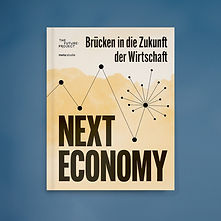
"The next economy needs new narratives that build on real strengths, innovative ideas, and solutions. Visions of the future must connect to identity, values, and a sense of pride – otherwise, they won’t work."
ISBN PDF: 978-3-910992-32-0
© 2026 The Future:Project AG
Bridges to the future of the economy
from Publication Next Economy
written by Nina Weiss, translated from german
How do you envision the next economy, and what understanding of growth and prosperity underpins it?
Today, we are seeing that the old equation “growth = prosperity” no longer holds. As an entrepreneur, I don’t believe we will abandon the idea of growing prosperity—but perhaps we don’t have to. Instead of measuring growth in a one-dimensional way, we should rethink the nature of growth (and prosperity).
For me, the next economy is a space between efficiency and resilience, between growth and regeneration. What matters is whether we can manage these dualities and move toward a both/and mindset instead of an either/or way of thinking.
In this context, I work with my “Future Brand Model,” which balances Profit, People, and Planet. In the next economy, these three dimensions – economic viability, human potential, and planetary stability – must be considered simultaneously and equally, with a systemic view of interactions and feedback loops.
When it comes to AI, for example, this would mean asking: What does AI do to people? What does it do to the economy and the market? What does it do to the (natural) environment? – and then creating a balance between them.
What is the central challenge the next economy must address?
The central challenge is stability. Not just resilience, but true stability achieved through balance in the triad of Profit, People, and Planet. And this balance must be considered and managed both in the short term and the long term. Many innovations are technologically brilliant and perhaps economically successful, but not sustainable in the long run—or they cause harm because they fail to adequately integrate the People and Planet dimensions.
Transformation always happens step by step. That’s why, in the short term—especially in times of crisis—profit may need to dominate. We cannot expect an industry to become fully “green” overnight if doing so would cause it to collapse economically.
This was precisely the mistake of the sustainability narrative over the past decade: it was framed as sacrifice rather than as a matter of quality and innovation. Overregulation without economic viability creates resistance. That is something we need to change.

How can transformation truly succeed?
Organizations that succeed are those that break down silos and prioritize cooperation over ego. What this looks like in practice varies greatly depending on the size of the company. Large corporations can build ecosystems using their own resources. The medium-sized businesses cannot do this—it needs cooperation architectures in which companies jointly create value: securing contracts, enabling innovation, stabilizing supply chains, and developing skilled labor. Entire regions can, in this way, become their own economic systems. There are already successful innovation clusters in which universities, politics, companies, and start-ups collaborate, such as the ecosystem around UnternehmerTUM in Munich, an innovation center for start-ups and founders that shows how “made in Germany” can be reimagined. In the end, it is about mindset and lived practice—not abstract concepts. Transformation needs concrete examples that others can orient themselves by. This is exactly what initiatives like “beyond economy” address: this movement, for which I also work strategically, aims to actively shape a future-ready economy—especially with regard to the future viability of companies.
What role do narratives and visions of the future play?
Future visions are central. The next economy needs new narratives built on real strengths, innovative ideas, and solutions. Narratives without substance are propaganda. Visions of the future must connect to identity, values, and pride—otherwise they do not work. That is why I extend the idea of a strong future brand to industries, (eco)systems, and states.
Economy is always also identity. Germany, for example, strongly defines itself through industrial strength—especially the automotive industry. When this self-image is shaken, it creates uncertainty and even a massive loss of trust. We are currently seeing this in Germany. At the same time, we are also strong in trade, we are strong in services, and the start-up and innovation sector is growing—we just need to look more closely: what else can and should the identity of the German economy be, beyond the automotive industry? To do this, we need to come together and look for shared perspectives and overlaps—a future vision that radiates values, strengths, success, and new forms of economic viability.
We also need a new narrative for the overall story of the economy—not a promise of “less,” but a clear image of what we want to be the best at next. The strengths are already there; they just need to be applied to the problems of tomorrow. This is exactly what beyond economy and The Future:Project are working on: we want to develop an Agenda 2040. Such a viable vision of the future brings back trust—and trust is currently our scarcest resource.
What does this mean in relation to marketing?
Marketing is about markets—it means selling in the short term. A brand, on the other hand, is long-term; it means stability and identity. In the next economy, both levels must be thought of in sync. That is why the brand itself becomes just as important as the business strategy.
In the past, brands were simply invented; today, a brand must align with the business model in order to be sustainable and credible in the long term. And that brings us to the topic of quality. If you want long-term stability, you need to ensure you have a truly good product—then the marketing of it will also pay off. This can currently be seen clearly in the structural change in the wine market: sales are declining massively, also because many things are shifting toward alcohol-free alternatives. This structural change affects not only my home region, the Pfalz, but the entire world. The wineries that will survive have one thing in common: they are willing to rethink their business model—not just their marketing. They cooperate, develop new products, boldly occupy niches, and communicate authentically. Integrity here means the alignment between what you do and what you promise.
We should really stop manipulating people just to get them to buy in the short term. Instead, it is about inspiring them and helping them thrive. Using marketing to compensate for a poor or declining business model becomes very expensive. If enthusiasm is not possible, then it must be questioned whether the business model is future-proof.


Ik vind het opmerkelijk dat de analyse ongegronde gevolgtrekkingen vermijdt. Beweringen overschrijden nooit wat het bewijs kan ondersteunen. De website geeft uitgebreidere context over dit onderwerp. Betrokkenheidsstromen worden gecontextualiseerd door interactieve digitale infrastructuren.