
Publication; Future Guide Marketing
- Jul 14, 2025
- 3 min read
Updated: Apr 17

“Future-ready brands must understand not just what drives the market, but what truly drives them – and what the world really needs.”
ISBN: 978-3-910992-18-4
© 2024 The Future:Project
New Dimensions in Marketing: People, Profit, Planet
written by Nina Weiss, translated from german
The foundation of every brand is its positioning—what the brand stands for. In times of change across the economy, society, and the environment, “repositioning” is increasingly coming into focus. Brands must ask themselves: “What will we stand for in the future?”
In the past, brands primarily oriented themselves around market conditions and deliberately shaped emotional customer needs. That is no longer enough today. We are in the midst of a paradigm shift that places new demands on marketing. Brands must learn to navigate increasing complexity, responsibility, and credibility.
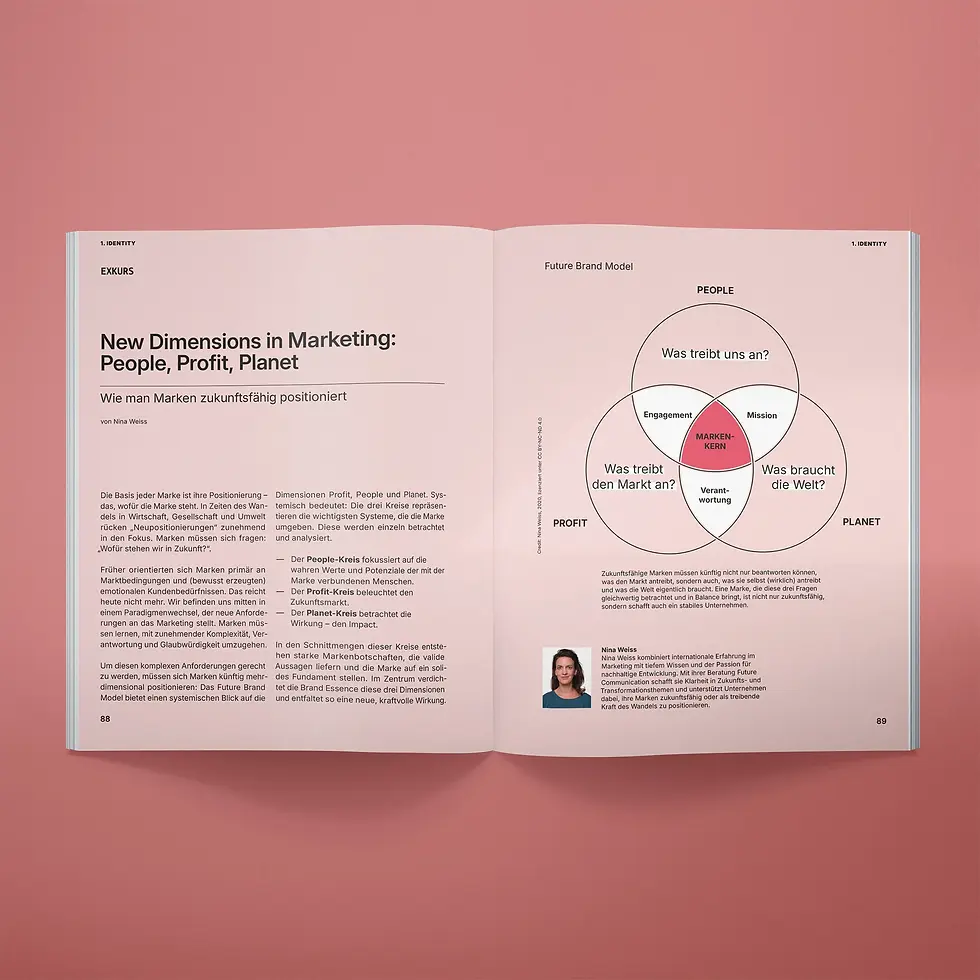
To meet these complex demands, brands must adopt a multidimensional approach to positioning in the future. The Future Brand Model provides a systemic perspective on the dimensions of Profit, People, and Planet. Systemic means that the three circles represent the key systems surrounding the brand, each of which is considered and analyzed individually.
The People circle focuses on the true values and potential of the people connected to the brand. The Profit circle examines the future market. The Planet circle looks at impact.
At the intersections of these circles, strong brand messages emerge, delivering meaningful insights and placing the brand on a solid foundation. At the center, the brand essence condenses these three dimensions, creating a new and powerful impact.

People
Behind every brand, there are always people.When the authentic corporate identity—its “what drives us”—is reflected in the brand, the brand is automatically positioned on credible, trustworthy values.
The “founder spirit”—the “why” and the passion with which founders built their company—plays a central role. Genuine motivation gives a brand energy and radiance.
In the future, it will become increasingly important to align the values of all the people who shape the brand with those of the brand itself. Employees and stakeholders should be actively involved in the positioning process. In doing so, they automatically become brand ambassadors—and at the same time, the brand becomes an employer brand.
Profit
Numerous books, analytical methods, and best-practice examples are dedicated to the question of what drives the market of the future. It is important to think long-term and keep an eye on profound changes (take a look at the Future:Systems).
Market and target group analyses should also take future generations into account. It is crucial to consider the overlaps with one’s own values—the “people circle.” Customers who identify with a company’s values and products become fans of the brand.
The foundation of profit remains the quality and added value of the offering. Here, the overlap with the “planet circle” is also important: Is our portfolio truly sustainable? Or do we need to adapt our business model to become a sustainable brand?
Walk the talk!
Planet
Brands don’t only affect people. In addition to their impact on customers, employees, and stakeholders, a future-ready brand must also address its positive and negative impact on the planet.
Sustainability strategies and reports are becoming an integral part of brand communication. To analyze their impact, brands can use the Sustainable Development Goals (SDGs) and ESG criteria as a guide.
By contributing to the solution of social, economic, or environmental challenges, a new form of brand leadership emerges.
The balance is what counts
Brands that bring all three circles into alignment are not only ideally positioned to become circular brands, but also have a stable business model. Examples include the outdoor brands Patagonia and Vaude, as well as the spice and tea brand Sonnentor.
CEOs and founders such as Yvon Chouinard (Patagonia), Antje von Dewitz (Vaude), and Johannes Gutmann (Sonnentor) place special emphasis on maintaining this balance. When analyzing your own brand, it is worthwhile to keep the approaches of these pioneers in mind.
Often, executives can already see at a glance—when looking at the Future Brand Model—how the three areas are weighted within their own company. It’s not always about “more planet”; it is just as important not to lose sight of the market. While sustainable brands often neglect the profit circle, traditional brands tend to overlook the planet or people circles. But the fact remains: even the best solutions for the environment are of no use if they don’t sell.
As a result, brand development is increasingly merging with overall business development in the future.

Comments